Graphs data structure, terminologies, usages and code examples
What are graphs
- Finite set of nodes and the nodes’s connections
Uses of graphs
- social networks
- locaiton/mapping
- routing
- recommendation engine
Terminology
- vertex -> node
- edge -> connection between nodes
- weighted/unweighted -> values assigned to distances between vertices
- directed/undirected -> directions assigned to distanced between vertices
undirected - a <-> b / a is connected to b and b is connected to a (2-way) directed - a -> b / a is connected to b but b is not connected to a (1-way)
weighted graph - edges have values / for example distances between 2 vertices can be the values. Google maps unweighted graph -edges have no values
Storing/representing graphs in code
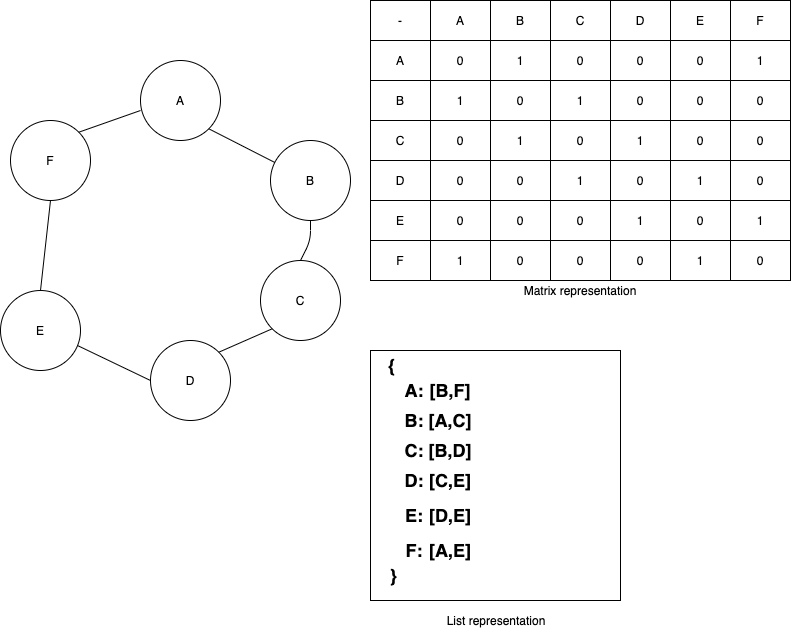
Using an adjacency matrix
- 2d matrix represented by 0 and 1. 1 meaning there is a connection between 2 vertices
- Takes up more space( in sparse graphs)
- Slower to iterate over all edges
- Faster to lookup specific edge
Using an adjacency list
- Using a hash table
{}. Key being the vertex and the value being the array of edges connection - Can take up less space(in sparse graphs)
- Faster to iterate over all edges
- Can be slower to lookup/query specific edge
Build out graph using adjacency list
Graph.js
class Graph {
  constructor() {
    this.adjacencyList = {};
  }

  addVertex(node) {
    if (this.adjacencyList[node]) {
      return;
    }

    this.adjacencyList[node] = [];
  }

  addEdge(vertex1, vertex2) {
    if (!this.adjacencyList[vertex1]) return;

    if (this.adjacencyList[vertex1]) {
      if (this.adjacencyList[vertex1].includes(vertex2)) {
        return;
      }
      this.adjacencyList[vertex1].push(vertex2);
    }

    if (!this.adjacencyList[vertex2]) return;

    if (this.adjacencyList[vertex2]) {
      if (this.adjacencyList[vertex2].includes(vertex1)) {
        return;
      }
      this.adjacencyList[vertex2] = [];
      this.adjacencyList[vertex2].push(vertex1);
    }
  }

  removeEdge(vertex1, vertex2) {
    if (!this.adjacencyList[vertex1] || !this.adjacencyList[vertex2]) return;

    if (
      this.adjacencyList[vertex1].includes(vertex2) &&
      this.adjacencyList[vertex2].includes(vertex1)
    ) {
      this.adjacencyList[vertex1] = this.adjacencyList[vertex1].filter(
        (v) => v !== vertex2
      );
      this.adjacencyList[vertex2] = this.adjacencyList[vertex2].filter(
        (v) => v !== vertex1
      );
      // const index = this.adjacencyList[vertex2].indexOf(vertex1);
      // this.adjacencyList[vertex2].splice(index, 1);
    }
  }

  removeVertex(vertex) {
    if (!this.adjacencyList[vertex]) return;

    while (this.adjacencyList[vertex]) {
      this.adjacencyList[vertex].forEach((element) => {
        this.removeEdge(vertex, element);
      });

      delete this.adjacencyList[vertex];
    }
  }
}

const g = new Graph();
g.addVertex("Tokyo");
g.addVertex("Dallas");
g.addVertex("Aspen");
g.addVertex("Hong Kong");
g.addVertex("Los Angeles");

g.addEdge("Tokyo", "Dallas");
g.addEdge("Tokyo", "Hong Kong");

g.addEdge("Dallas", "Tokyo");
g.addEdge("Dallas", "Aspen");
g.addEdge("Dallas", "Hong Kong");
g.addEdge("Dallas", "Los Angeles");

g.addEdge("Aspen", "Dallas");

g.addEdge("Hong Kong", "Tokyo");
g.addEdge("Hong Kong", "Dallas");
g.addEdge("Hong Kong", "Los Angeles");
g.addEdge("Los Angeles", "Hong Kong");
g.addEdge("Los Angeles", "Dallas");

{
  Tokyo: [ 'Dallas', 'Hong Kong' ],
  Dallas: [ 'Tokyo', 'Aspen', 'Hong Kong', 'Los Angeles' ],
  Aspen: [ 'Dallas' ],
  'Hong Kong': [ 'Dallas', 'Tokyo', 'Los Angeles' ],
  'Los Angeles': [ 'Hong Kong', 'Dallas' ]
}

g.removeVertex("Hong Kong");

{
  Tokyo: [ 'Dallas' ],
  Dallas: [ 'Tokyo', 'Aspen', 'Los Angeles' ],
  Aspen: [ 'Dallas' ],
  'Los Angeles': [ 'Dallas' ]
}
Traversal of graphs
- Uses of traversal
- finding closest matches/recommendations
- shortest path problems
- gps navigation
- shortest path to win a game logic
Depth-first traversal
Pseuodcode flow for recursive
- The function should accept a starting node
- Create an array to store the end result, to be returned at the very end
- Create an object to store visited vertices
- Create a helper function which accepts a vertex
- The helper function should return early if the vertex is empty
- The helper function should place the vertex it accepts into the visited object and push that vertex into the result array.
- Loop over all the values in the adjacencyList for that vertex
- If any of those values have not been visited, recursively invoke the helper function with that vertex
- Invoke the helper function with the starting vertex
- Return the result array
Using class properties
class Graph{
  constructor(){
    this.result = []
    this.visitedVertices = {};
    this.adjacencyList = {}
  }

 depthFirstTraversal(vertex) {
    this.dfsRecur(vertex);
    return this.result;
  }

  dfsRecur(vertex) {
    if (!vertex) return;

    this.result.push(vertex);
    this.visitedVertices[vertex] = true;

    this.adjacencyList[vertex].forEach((n) => {
      if (!this.visitedVertices[n]) {
        this.dfsRecur(n);
      }
    });
  }
}


Using functions/closures

  depthFirstTraversal(vertex) {
    const result = [];
    const visitedVertices = {};

    const dfsRecur = (vertex) => {
      if (!vertex) return;
      visitedVertices[vertex] = true;
      result.push(vertex);

      this.adjacencyList[vertex].forEach((n) => {
        if (!visitedVertices[n]) {
          return dfsRecur(n);
        }
      });
    }
    dfsRecur(vertex);
    return result;
  }
Pseudocode for DFS iterative
- function accepts a start vertex
- Create stack to help keep track of vertices in the form of array (LIFO)
- Create a result array to store results, returned at the very end
- Create an object to store visited vertices
- Add starting vertex to stack and mark it visited
- while stack is not empty
- pop next vertex from stack
- push vertex into result array
- loop over vertex neighbours
- check if neighbour have not been visited
- mark neighbour as visited
- push neighbour into stack
- check if neighbour have not been visited
  dfsIterative(vertex) {
    const stack = [];
    const discovered = {};
    const result = [];
    let currentVertex;

    stack.push(vertex);
    discovered[vertex] = true;

    while (stack.length !== 0) {
      currentVertex = stack.pop();
      result.push(currentVertex);

      this.adjacencyList[currentVertex].forEach((neighbor) => {
        if (!discovered[neighbor]) {
          discovered[neighbor] = true;
          stack.push(neighbor);
        }
      });
    }
    return result;
  }
Breadth first traversal
- use a queue to keep track of vertices
Pseudocode for BFS
- Function should accept a starting vertex
- Create a queue and place starting vertex in it (FIFO)
- Create an array to store the nodes visited and return at end of function
- Create an object to store nodes visited
- Make starting vertex as visited
- Loop as long as there is something in the queue
- Remove the first vertex from the queue and push it into the array that stores nodes visited
- Loop over the vertex in the adjacency list for the vertex that you are visiting
- if it is not inside the object that stores the nodes visited, mark it as visited and enqueue that vertex
- Return result array of visited nodes
 bfs(vertex) {
    const visited = {};
    const queue = [vertex];
    const result = [];
    let currentVertex;

    visited[vertex] = true;

    while (queue.length) {
      currentVertex = queue.shift();
      result.push(currentVertex);

      this.adjacencyList[currentVertex].forEach((neighbor) => {
        if (!visited[neighbor]) {
          visited[neighbor] = true;
          queue.push(neighbor);
        }
      });
    }
    return result;
  }